

How to Stop Dachshund Barking: 7 Things To Try


If you want to stop a Dachshund from barking excessively, first figure out what is causing the barking. Alert barking, boredom, demand barking, fear, and separation-related barking need different approaches. For many Dachshunds, the most useful combination is reward-based “quiet” training, reducing visual and sound triggers, providing daily sniffing and mental enrichment, and creating a predictable routine.
If your Dachshund seems capable of hearing a delivery driver three streets away, you already know how seriously this breed takes barking.
The doorbell rings? Bark.
A neighbor closes a car door? Bark.
Someone walks past the window carrying a suspicious-looking grocery bag? Definitely bark.
It can become exhausting, especially when you have tried saying “no,” closing the curtains, distracting your dog, and eventually begging for five minutes of silence.
But living with Dachshunds has taught us something important: trying to stop the noise without understanding why the dog is barking usually gets you nowhere.
Dachshunds are not quiet little lapdogs that somehow picked up an annoying habit. They were bred to be persistent hunting dogs, and being vocal was useful.
The goal, therefore, is not to create a Dachshund that never barks.
It is to teach your dog that they can notice something without turning every small event into a five-minute emergency.
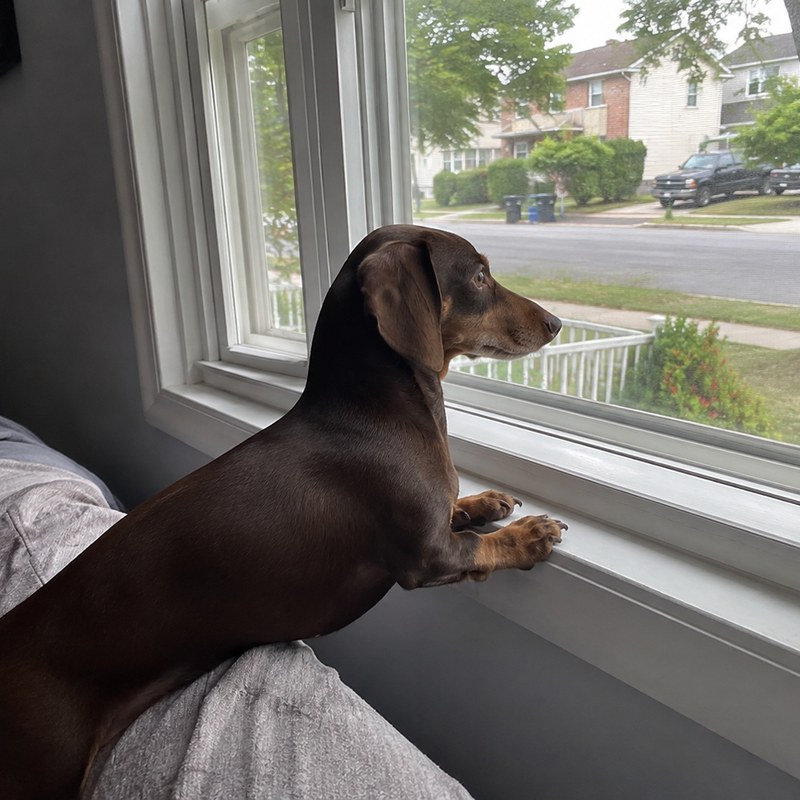
For many Dachshunds, movement outside a window is one of the biggest triggers for alert barking.
Why Do Dachshunds Bark So Much?
Part of the answer goes back hundreds of years.
Dachshunds were developed in Germany as hunting dogs capable of working underground. Their work required persistence, independence, courage, and a voice that could help a hunter locate the dog while it was underground. The American Kennel Club still describes barking as one of the behaviors connected with Dachshunds’ earthdog heritage.
That does not mean every modern Dachshund will bark constantly.
It does mean that being alert, vocal, and interested in what is happening around them comes naturally to many dogs of this breed.
The more useful question is:
What is your Dachshund trying to accomplish by barking?
Once you know that, training becomes much easier.
First, Work Out What Kind of Barking You Are Dealing With
Not every bark means the same thing.
Before changing anything, watch your dog for a few days and pay attention to what happens immediately before the barking starts.
Alert barking
This is the classic Dachshund alarm system.
Your dog may bark when:
- someone approaches the door
- a dog walks past the house
- a car pulls into the driveway
- the elevator stops outside your apartment
- your neighbor makes noise
- someone enters the garden
Your Dachshund has noticed something and wants everyone else to know about it too.
Demand barking
This sounds more like:
“Throw my toy.”
“Give me that food.”
“Open the door.”
“Look at me.”
If barking regularly gets your Dachshund what they want, they learn very quickly that it works.
Boredom barking
A Dachshund with very little to do can become surprisingly creative.
Staring out the window and announcing every pedestrian can easily turn into the day’s main activity.
Fear or anxiety-related barking
This type deserves more careful attention.
The barking may happen around unfamiliar people, other dogs, particular noises, or situations your Dachshund finds uncomfortable.
Barking when left alone
If barking begins shortly after you leave home, look at the bigger picture.
Is your dog simply responding to outside sounds while you are away?
Or are they pacing, whining, scratching the door, howling, refusing food, or becoming destructive?
Those are very different situations.
A Small Lesson I Learned From My Own Dog
One of my dogs used to chew my slippers when I went out.
It was easy to look at the destroyed slippers and think, Why are you doing this again?
Eventually, I realized that the slippers were not really the problem.
The behavior happened specifically when I was away. Chewing appeared to be one of the ways he coped with being unsettled when left alone.
That changed the way I looked at unwanted behavior in general.
Instead of starting with:
“How do I stop this?”
I started asking:
“Why is my dog doing this in the first place?”
I use the same approach with barking.
A Dachshund barking because someone passed the window needs a different solution from a Dachshund barking because being alone causes distress.
That distinction matters.
How to Stop a Dachshund From Barking: 7 Things I Would Try
There is no magic word that switches off a Dachshund’s bark.
These are the approaches I would start with.
1. Teach “Quiet” Without Shouting
It sounds slightly ridiculous when you think about it.
The dog is barking.
The owner starts shouting:
“QUIET! STOP! NO!”
Now everyone is making noise.
For an already excited Dachshund, that can add even more energy to the situation.
Instead, practice rewarding the behavior you actually want.
When your Dachshund barks:
- Stay relatively calm.
- Wait for a brief pause.
- Say your chosen cue, such as “quiet.”
- Reward the silence immediately.
- Gradually ask for a slightly longer pause before rewarding.
At first, you might only get one second of silence.
Take it.
You are building an association between your cue, stopping the bark, and something positive happening.
Keep the sessions short. Two or three minutes of successful practice is better than continuing until both of you are frustrated.
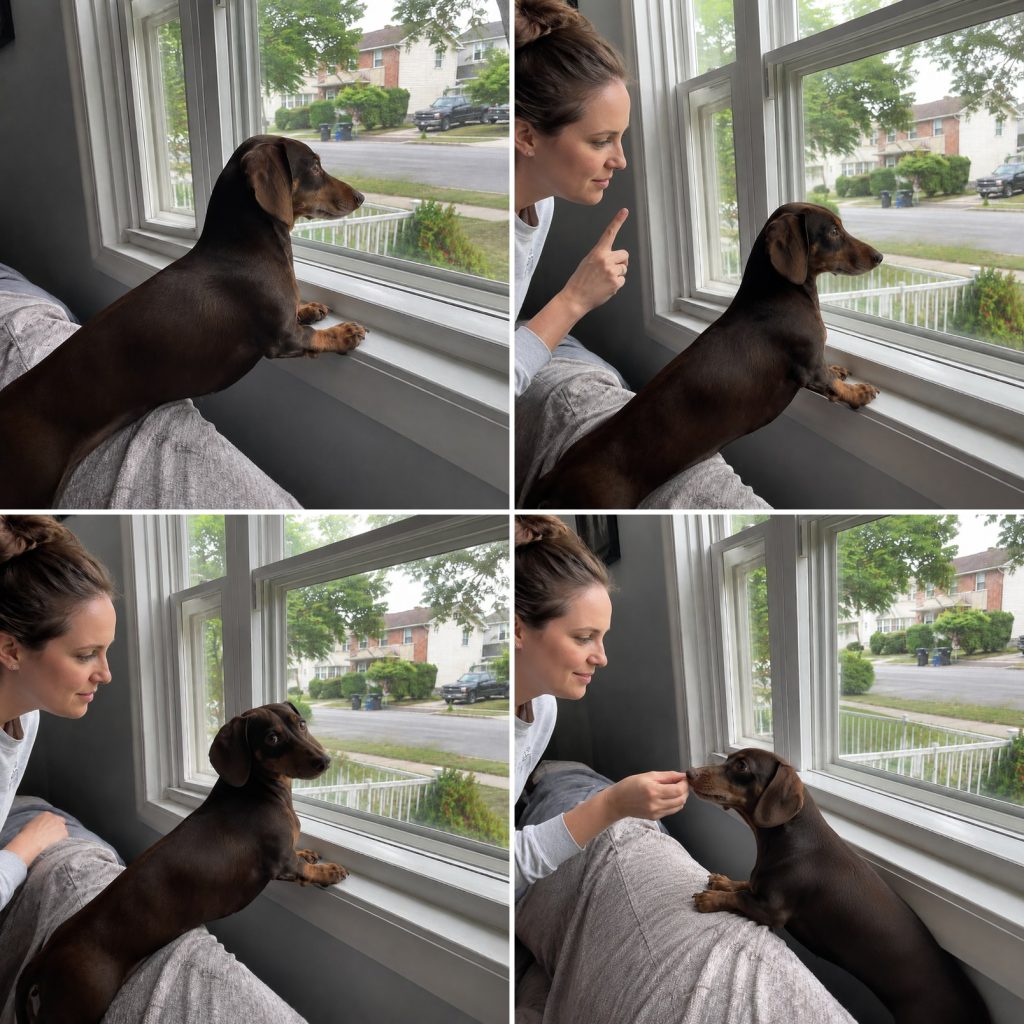
Teaching Our Dachshund the Quiet Cue at Home
2. Stop Making the Window a Full-Time Security Job
Sometimes training your Dachshund is only half of the solution.
The other half is changing their environment.
Imagine your dog’s bed faces a large window overlooking a busy sidewalk.
Twenty people pass.
Three dogs walk by.
A delivery van stops.
Someone rings the bell.
From your Dachshund’s point of view, they have spent the entire afternoon successfully protecting the house.
And every time they bark, the suspicious person eventually disappears.
That can make the behavior very rewarding.
Try:
- moving the bed away from the window
- closing curtains during busy periods
- using privacy film on the lower part of a window
- using gentle background noise if hallway sounds trigger barking
- giving your dog another comfortable resting location
You’re not “giving up” on training.
You’re simply reducing the number of times your dog rehearses the unwanted behavior.
3. Practice With Predictable Triggers
The doorbell is a good example because you can reproduce it.
Start with a recording played quietly.
If your Dachshund notices it but remains calm, reward them.
Repeat.
Later, increase the volume slightly.
Eventually, practice with the actual bell.
The important part is working below the point where your dog completely loses focus.
If your Dachshund is barking frantically and will not take food or respond to you, the exercise is too difficult at that moment.
Make it easier.
Training does not have to look dramatic to work.
Most useful behavior training is actually quite boring to watch: tiny repetitions, small improvements, and lots of consistency.
4. Give That Nose Something Better to Do
A twenty-minute walk where your Dachshund is allowed to investigate smells can be very different from a twenty-minute march where the dog is constantly pulled away from everything interesting.
Dachshunds are scent hounds.
Let them sniff.
At home, you can hide several pieces of food around a safe room and encourage your dog to find them.
You can also:
- scatter part of a meal for your dog to search for
- hide treats inside a rolled towel
- use food puzzles
- practice basic scent games
- rotate toys instead of leaving every toy available all day
- teach simple tricks for a few minutes at a time
You do not need expensive equipment.
The purpose is to give your Dachshund something to think about besides the neighbor’s front door.

Sniffing and problem-solving give Dachshunds an appropriate outlet for behaviors connected with their scent-hound heritage.
5. Be Careful With Demand Barking
This one can sneak up on you.
Your Dachshund barks next to the toy basket.
You throw the ball.
Tomorrow, they bark again.
You throw it again.
A week later, your dog has trained you very efficiently.
If you are confident that your dog’s genuine needs have been met, avoid immediately giving them what they are demanding while they are barking.
Wait for calm.
Then offer attention, play, food, or whatever is appropriate.
The timing makes a difference.
You want:
Quiet → good things happen
rather than:
Bark repeatedly → humans eventually surrender
6. Make the Day More Predictable
Dachshunds do not need every minute scheduled.
But a loose routine can make daily life easier.
For example:
Morning: toilet break → sniffing walk → breakfast
Midday: rest → short enrichment activity
Afternoon: walk or play
Evening: dinner → calm family time → final toilet break
A predictable pattern can be particularly useful for dogs that spend a lot of their day waiting for something exciting to happen.
It also helps you notice patterns.
If barking always increases at 5 p.m., ask what is happening at that time.
Maybe your Dachshund expects dinner.
Maybe neighborhood dogs are outside.
Maybe your dog has simply spent several hours without activity.
That information is useful.
7. Know When Barking Is Not a Training Problem
This point is especially important with Dachshunds.
If a normally quiet dog suddenly becomes unusually vocal, cries when being lifted, seems reluctant to move, or begins behaving differently, do not automatically assume you have a barking problem.
Pain can change behavior.
Cornell University’s College of Veterinary Medicine lists Dachshunds among breeds predisposed to CDDY/IVDD. Its guidance includes reluctance to jump or walk, reluctance to be lifted, a stiff neck or arched back, unusual reactions to touch, and “vocalization when moving” among possible signs of neck or back pain.
If you notice these symptoms, contact your veterinarian.
Especially watch for:
- crying or yelping during movement
- reluctance to walk
- sudden refusal to jump
- weakness
- wobbling
- dragging or knuckling a paw
- an arched back
- neck stiffness
- unusual sensitivity when touched
- difficulty standing or walking
Neurological symptoms can require urgent veterinary attention.
Veterinary reference: Cornell University College of Veterinary Medicine — Chondrodystrophy and Intervertebral Disc Disease (CDDY/IVDD)
Medical note: This article is educational and should not be used to diagnose pain, IVDD, anxiety disorders, or other medical conditions. Contact your veterinarian if your dog’s behavior changes suddenly or you are concerned about their health.
Should You Use a Bark Collar on a Dachshund?
We do not recommend shock collars or other aversive methods as a shortcut for barking.
There is an important distinction between suppressing a bark and solving the reason behind it.
A dog may stop making noise while still feeling frightened, frustrated, or distressed.
The American Veterinary Society of Animal Behavior (AVSAB) states that reward-based methods should be used for dog training and behavior modification and advises against aversive methods, including electronic collars.
That is why our approach is based on rewarding the behavior we want, managing triggers, and addressing the reason for the barking.
What If My Dachshund Barks at the Door?
I would not make “never bark at the door” the first goal.
For many Dachshunds, one or two alert barks are a realistic form of communication.
Instead, teach what comes after the bark.
For example:
Knock → bark → “thank you/quiet” → go to bed or mat → reward
Now your dog has a sequence to follow.
That is much clearer than repeatedly telling them what not to do.
You can practice when no real visitor is coming.
Have a family member knock gently, ask your Dachshund to go to their place, and reward them there.
Increase the difficulty gradually.
What If My Dachshund Barks When I Leave?
This situation deserves its own section because not all barking during departures is separation anxiety.
Set up a camera and watch what actually happens.
A Dachshund that sleeps for twenty minutes and then barks when a delivery driver arrives is different from a dog that begins pacing, barking, panting, scratching, or howling immediately after you leave.
If your dog appears genuinely distressed, do not assume they simply need to “cry it out.”
Separation-related behavior can be complicated, and severe cases are worth discussing with a veterinarian or qualified behavior professional.
For milder difficulty being alone, start with departures short enough that your dog can handle them and build duration gradually.
Do not jump from two calm minutes to three hours.
Recommended Gear for a Calmer Routine
These products are optional training-support items, not treatments for barking, anxiety, or behavioral disorders.
For Mental Enrichment
Dachshund IQ Feeder Toy
Useful for adding problem-solving to meals and slowing down dogs that otherwise finish food quickly.
View the Dachshund IQ Feeder Toy

For Hide-and-Find Play
Carrot Plush Interactive Dachshund Toy
Can be incorporated into simple searching and interactive play sessions.
View the Carrot Plush Interactive Toy

For a Comfortable Resting Area
Calming Dachshund Heartbeat Toy
A soft comfort toy that can be placed in your Dachshund’s resting area if your dog enjoys sleeping beside plush toys.
View the Calming Dachshund Heartbeat Toy

For Warmth and Comfort
Dachshund Hoodies
Designed around a Dachshund’s long-backed body shape and useful primarily for warmth and everyday comfort.
Important: None of these products should be presented as a cure for separation anxiety or excessive barking. If a dog shows significant fear or distress, professional behavioral or veterinary guidance is more appropriate.
How Long Does It Take to Stop a Dachshund From Barking?
I would be suspicious of anyone promising you a specific number of days.
Dogs are different.
Triggers are different.
And the reason behind the barking matters more than the calendar.
A Dachshund barking at people through one particular window may improve quickly once you change the environment and begin training.
A dog with long-established reactivity or severe separation distress may need considerably more work.
Instead of counting days, look for smaller signs of progress.
Is your Dachshund:
- barking fewer times?
- stopping sooner?
- responding to “quiet” more reliably?
- recovering faster after someone passes the window?
- able to notice a trigger without immediately reacting?
- settling more easily?
Those changes matter.
When Should You Get Professional Help?
Consider speaking with your veterinarian or a qualified dog behavior professional if your Dachshund:
- barks or howls for long periods when alone
- panics during departures
- attempts to escape
- injures themselves
- becomes aggressive around visitors
- reacts intensely to other dogs or people
- cannot recover after a trigger disappears
- suddenly develops barking alongside physical or behavioral changes
For significant fear, aggression, or separation-related problems, professional guidance can save a lot of trial and error.
Frequently Asked Questions About Dachshund Barking
Why does my Dachshund bark at everything?
Dachshunds tend to be alert and vocal dogs, and their hunting heritage is part of the reason. Your dog may also have learned that barking successfully makes people, dogs, and other perceived “intruders” disappear.
Look for patterns before deciding how to train the behavior.
How do I stop my Dachshund barking at people walking past the house?
Start by limiting the dog’s view when you cannot actively train. Then work at a distance or intensity where your Dachshund can notice people without becoming overwhelmed. Reward calm behavior and gradually make the exercise more difficult.
Can I teach a Dachshund to stop barking on command?
You can teach many Dachshunds a reliable “quiet” cue, but expecting a dog never to bark is unrealistic.
The more useful goal is fewer unnecessary barking episodes and faster recovery after a trigger.
Why does my Dachshund bark when I leave the house?
Possible reasons include outside triggers, boredom, frustration, or separation-related distress.
Use a camera to see what happens after you leave rather than guessing from what you hear at the door.
Should I ignore my Dachshund when they bark?
Sometimes.
Ignoring demand barking may be useful when you know your dog’s needs are already met.
But a frightened dog, a dog experiencing separation distress, and a dog vocalizing because of pain should not simply be treated as attention-seeking.
The cause matters.
Can pain make a Dachshund bark or cry more?
Yes. Sudden vocalization or crying, particularly when moving or being handled, can be associated with pain. Cornell specifically includes vocalization during movement among possible signs of neck or back pain associated with CDDY/IVDD.
A sudden change in behavior deserves veterinary attention.
The Goal Isn’t a Silent Dachshund
I don’t think a completely silent Dachshund should be the standard for successful training.
These dogs were bred to notice things and make themselves heard.
That personality is part of what makes living with them entertaining—even when it occasionally drives us mad.
What we can teach them is an off-switch.
Let your Dachshund sniff. Give them things to investigate. Reduce unnecessary triggers. Reward calm moments before they become barking episodes. Practice the same skills when life is quiet, not only when someone is already standing at the front door.
And above all, pay attention to what the barking is telling you.
Sometimes it means:
“There’s someone outside.”
Sometimes it means:
“I’m bored.”
Sometimes it means:
“I don’t know how to cope with being alone.”
And occasionally it may mean:
“Something hurts.”
Once you know which conversation your Dachshund is trying to have with you, helping them becomes much easier.






 Dachshund Jackets & Coats
 Dachshund Hoodies
 Dachshund Sweaters
 Dachshund Shirts
 Dachshund Life Jackets
 Dachshund Costumes
 Dachshund Pajamas


 Dachshund Harnesses
 Dachshund Collars




 Dachshund Backpacks